The verdict: insurers pay for events, not for processes
The line an adjuster draws is not between damage and no damage, it is between a sudden event and a condition that developed over seasons. The notebook makes the distinction explicit in the case of the biological damage: insurers classify termite damage as a preventable pest problem rather than a sudden or accidental loss, which is why that repair bill comes out of the owner's pocket. Apply the same test to everything else on the claim and the documentation requirement becomes obvious — a claim needs a date and a cause, and a foundation failure that built up over ten years does not supply either unless the record does. If the failure is real but has never been measured, the first useful step is not a claim; it is a 60–90 minute inspection that produces readings with dates.
The notebook also flags a coverage problem that has nothing to do with the loss: it records that many standard insurance carriers will flat out refuse to cover homes that still have active knob-and-tube wiring, and that the NEC prohibits standard NM cable in damp locations under 334.12(B)(4), requiring UF-B, NMC or MC cable instead, with GFCI protection on crawl space receptacles and lighting under 210.8(A). A code violation in the space where the loss occurred gives a carrier a second reason to decline, independent of the foundation question. Fixing the wiring is not just safety work; it removes an argument.
The short version
- Insurance answers whether damage was a sudden event with a date and cause or a condition that developed over seasons, and a foundation failure building for ten years supplies neither unless the record does.
- The notebook records that many standard carriers refuse to cover homes with active knob-and-tube wiring, and NEC 334.12(B)(4) prohibits standard NM cable in damp locations, requiring UF-B, NMC or MC instead.
- The evidence pack captures deflection in fractions of an inch with dates, wood moisture against a 19% ceiling, crawl space humidity against a 60% control line and probe results per joist.
- If the carrier calls the loss gradual because it has no date, the response is dated readings across four to six weeks with an engineer's report naming the failure mode.
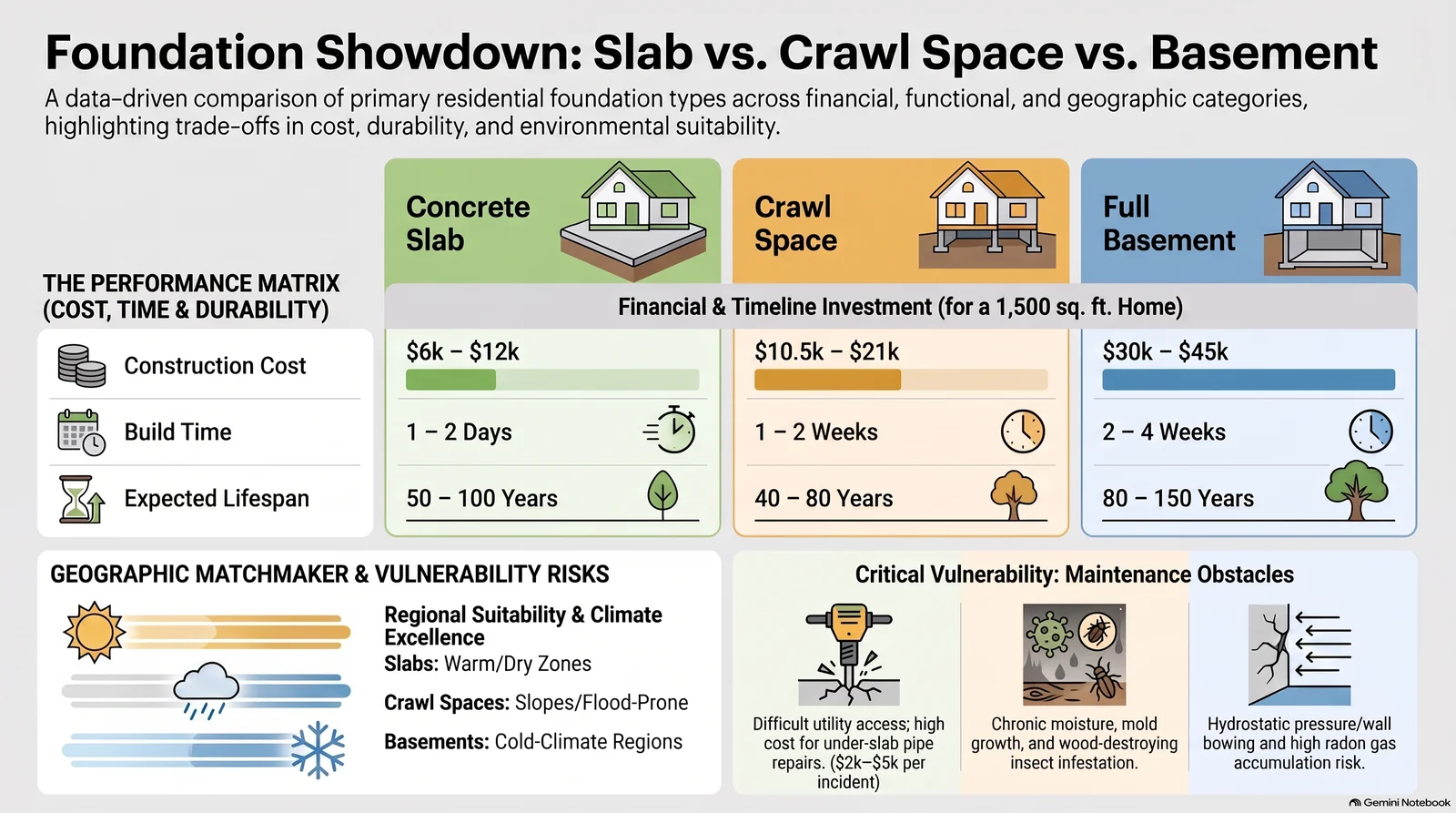
- Where coverage does not apply the owner funds everything, and the bands are $2,500-$6,000 for targeted support, $6,000-$15,000 once the failure spreads, and $15,000-$30,000 or more for severe compromise.
- The gap between the $2,500-$6,000 early band and the $15,000-$30,000+ late band is six to twelve times the money, and the only reason to accept the larger number is the absence of early records.
How each kind of loss gets classified
| What happened | How it is classified | Evidence that decides it | Notebook position |
|---|---|---|---|
| Termite or wood-destroying insect damage | Preventable pest problem, not a sudden loss | Treatment record, probe-test findings, mud tubes | Notebook: rarely covered, so the owner pays |
| Rot and decay from long-term moisture | Deferred maintenance | Humidity log; wood moisture above 19% | Notebook: moisture control is the owner's duty |
| Movement from soil heave and settlement | Gradual process, not an event | Dated deflection readings; seasonal crack cycle | Notebook: expansive clay drives it, season by season |
| Water entering through grade or gutters | Maintenance failure in most readings | Drainage measurements; 5% slope, 10 ft downspouts | Notebook: correct grade and discharge first |
| Damp-location wiring violation | Code compliance, separate from the loss | Cable type, splice boxes, GFCI test | Notebook: NM prohibited; harnesses may refuse the risk |
| A single dated event with a clear cause | Event | Photographs, date, plumber's or engineer's report | The notebook's sudden-versus-preventable line is the test |
The documentation pack that decides the answer
Documentation is the only part of a claim the owner fully controls, and it is cheap next to the repair bands. The notebook's numbers tell you what to capture: deflection in fractions of an inch with dates, wood moisture content against a 19% framing ceiling, crawl space relative humidity against a 60% control line with a 30–50% target, probe-test results per joist, soil-to-wood clearance against a 6 inch rule, and the radon reading against the 4 pCi/L action level, which matters before and after a space is sealed because sealing changes air exchange. Two readings four to six weeks apart are worth more than one photograph, because they establish direction and rate — which is precisely what a gradual-loss exclusion is built to test.
| Item in the pack | Why it decides the claim | Notebook figure it uses |
|---|---|---|
| Dated deflection readings, two or more | Shows whether movement is event-like or continuous | Fractions of an inch, measured at the same points |
| Wood moisture content at three joists | Separates sudden water from chronic damp | 19% framing ceiling; 16% WME on gypsum board |
| Crawl space humidity log | Establishes the moisture condition and its duration | Above 80% typical; below 60% target |
| Probe-test results per joist | Evidence of internal damage the exterior hides | Dull thud or sinking tip means channel damage |
| Termite inspection and treatment record | The notebook's classification turns on prevention | Up to 16 g of structural wood per colony per day |
| Radon reading, before and after sealing | Safety condition created by the repair itself | EPA action level 4 pCi/L |
| Contractor licence and invoice | Proof the work was done by a licensed party | Structural work needs a licensed Residential Building Contractor |
When the answer is no
A decline is usually a classification decision, not a factual one, which makes it answerable with evidence rather than argument. Ask for the reason in writing. If the carrier is calling the loss gradual because it has no date, the dated reading set is the response — deflection across four to six weeks, humidity against the 60% line, moisture content against 19% — with an engineer's report naming the failure mode. If the carrier is treating it as a code or maintenance matter, the wiring evidence matters, because the notebook records that NM cable is prohibited in damp locations under 334.12(B)(4) and that some carriers refuse homes with active knob-and-tube wiring outright. Correcting it removes the argument; documenting it before the loss removes it twice.
What stays out of pocket
Where coverage does not apply, the plan is arithmetic. The notebook's bands are the budget: $2,500–$6,000 for targeted support in years one to two, $6,000–$15,000 once the failure spreads, and $15,000–$30,000 or more for severe compromise — plus encapsulation at $2,000–$8,000 and slab access at $2,000–$5,000 per incident when plumbing is involved. Since the pest and moisture categories are the ones most often excluded, the cost of delay is borne entirely by the owner: the mid band is roughly 2.5 times the early band ($15,000 ÷ $6,000 = 2.5), so a claim that fails and a repair that waits produce the same escalation. Treat the repair as self-insured and schedule it against the failure stage rather than against a claims decision.
The cost by category, and who carries it
| Category of work | Notebook band | Typical classification | Who pays |
|---|---|---|---|
| Targeted structural support | $2,500–$6,000 | Gradual settlement | The owner, in most readings |
| Multi-bay stabilisation and sistering | $6,000–$15,000 | Gradual, usually moisture-driven | The owner |
| Severe compromise, member replacement | $15,000–$30,000+ | Long-term neglect | The owner |
| Encapsulation and dehumidification | $2,000–$8,000 | Maintenance condition | The owner |
| Slab access for under-floor plumbing | $2,000–$5,000 per incident | An event where the cause has a date | Depends on whether the cause is dated |
| Damp-location rewiring, UF-B, NMC or MC with GFCI | Part of the electrical scope | Code compliance rather than a loss | The owner |
What turns a process into an event
An event has a date and a witness, and both are cheap to create in advance. A plumber's invoice for a burst line, a photograph of water on the liner taken the morning it was found, a humidity reading that moved from below 60% to above 80% between two logged dates, an inspection report that recorded sound framing a year before a sag appeared — each is a discrete point the gradual-loss argument cannot absorb. The notebook's numbers show why that matters: the gap between the $2,500–$6,000 early band and the $15,000–$30,000+ late band is six to twelve times the money ($15,000 ÷ $2,500 = 6; $30,000 ÷ $2,500 = 12), and the only reason to accept the larger number is the absence of early records. Take the reading before something happens, not after it.
Local calibration: why this market produces gradual losses
Shreveport sits on Louisiana conditions that make a foundation loss look gradual on paper. NRCS map units for Caddo Parish put depth to water table at about zero inches in the Latanier and Moreland clay units, with saturated permeability of 0.00–0.06 inches per hour in the Latanier and 0.01–0.06 inches per hour in the Moreland, both in Hydrologic Soil Group D; the Moreland series runs 60–90% clay with a coefficient of linear extensibility of 0.09–0.12 in the upper 40 inches, and published testing records a liquid limit of 79, a plasticity index of 51 and an activity of 1.3, naming soil heave as a primary structural concern. Add crawl space humidity that routinely exceeds 80%, and the result is damage that accumulates season by season rather than on a date — which is exactly the profile a maintenance exclusion is written for. That is the argument for inspection and repair records: they convert a process into a documented, dated, priced condition that a buyer, a lender or an adjuster can act on.
Decision matrix: claim, repair, or document first
| If this is true | Then do this | Because |
|---|---|---|
| Damage appeared after one dated incident | Collect the evidence immediately and file | The notebook's line is sudden versus preventable |
| Damage has accumulated over seasons | Inspect, measure, then repair and document | A gradual loss will be read as maintenance |
| Termites or decay are the cause | Treat and repair, plan to fund it yourself | Notebook: classed as a preventable pest problem |
| Active knob-and-tube or NM cable is present | Bring wiring to UF-B, NMC or MC with GFCI before claiming | Notebook: harnesses may refuse the risk outright |
| Humidity stays above 60% after sealing | Re-check the enclosure, dehumidifier and water source | Only a live water source needs a drainage fix |
| Coverage is unclear | Ask the carrier, in writing, which classification applies | Get the sudden versus maintenance decision on the record |
Contractor spec-handoff checklist
- Start with the readings, not the claim: a 60–90 minute inspection with measurements at multiple points, dated.
- Ask the carrier in writing to state whether the loss is treated as a sudden event or a maintenance condition — the notebook's classification line.
- Submit dated deflection readings across at least four to six weeks, wood moisture content against 19%, and a humidity log against 60%.
- Include probe-test results per joist, plus mud tube and soil-to-wood clearance findings against the 6 inch rule.
- Include the radon reading at the 4 pCi/L action level, taken before and after any sealing scope.
- Provide the wired-condition evidence: cable type, splice boxes, GFCI protection, and the NEC references the notebook names.
- Document the repair with a licensed contractor's invoice and licence confirmation on lslbc.gov.
- Regardless of the claims outcome, sequence water first and structure second; call (318) 206-4167 for a local assessment.