Termites or Wood Rot? The Probe Test for a Shreveport Foundation
The damage that ends load-bearing framing rarely starts in the living room. Subterranean termites and wood-decay fungi both work from the inside of a member outward, leaving the surface intact until the core is gone. A joist can look clean under a bright flashlight while its interior has been hollowed along the grain. In northern Louisiana that risk is not theoretical: the LSU AgCenter documents Formosan subterranean termites causing severe economic loss in the state, with damage running into the hundreds of millions of dollars annually, concentrated heavily around New Orleans but present wherever damp wood meets soil. The test that exposes it costs nothing and takes ten minutes.
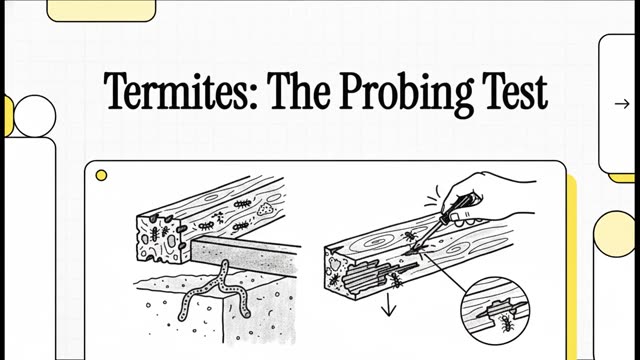
How the probe test works, and what each result means
Take a heavy screwdriver and a flashlight into the crawl space. Tap the plastic handle firmly against the joist or sill plate and listen, then push the metal tip into the wood and feel how far it travels. Sound framing rings sharply and stops the tip cold. A dull hollow thud means material has been removed from the core. A tip that sinks with little resistance means the member has lost its section. Sample several joists in the same bay rather than one, because galleries and decay are rarely uniform, and the contrast between a solid member and a soft one is the evidence. Record the date, location and condition of every soft spot: that record is what an engineer's report and a licensed pest treatment are built on.
| Feedback | What it indicates | Next step |
|---|---|---|
| Sharp ring, tip stops | Sound member at that location | Sample more joists and the sill plates |
| Dull hollow thud | Interior channels eaten out; gallery damage | Photograph; book a licensed pest inspection |
| Tip sinks, spongy feel | Active decay or termite damage | Treat as structural; engineer before pricing |
| Wood stays wet or stained | The moisture precondition for both rot and termites | Find the water source before treating anything |
Mud tubes and the rest of the evidence trail
Termites live in soil and eat wood above it, so they commute. Subterranean termites build mud tubes — pencil-thick highways of soil and saliva along foundation walls and piers — to travel from wet ground to framing without exposure to air or predators. A tube on a concrete wall is direct evidence that the concrete is being bypassed. The biology sets the timeline: Utah State University Extension reports that a mature subterranean colony can exceed one million members, forage across roughly 24,000 square feet, and consume up to a pound of structural wood per day. That is continuous feeding around the clock, for months or years, before a floor visibly sags — and because insurance treats the damage as preventable, the repair money comes out of pocket.
| Evidence | Where to look | What it means |
|---|---|---|
| Mud tubes | Concrete walls and piers near sill plates | Active termites bypassing the concrete |
| Swarmers or shed wings | Sills, window ledges, crawl space access | A colony in or adjacent to the structure |
| Blistered or bubbling paint | Sills and trim above damp soil | Moisture trapped behind a finished surface |
| Frass or coarse sawdust | Under joists and along beam ledges | Feeding activity in the member above |
| Soft sill plates | Along the top of the foundation wall | The load-transfer line has lost section |
Why Shreveport crawl spaces are the worst case in this market
Termites are a moisture story before they are a wood story, and Caddo Parish is wet by geography. NRCS mapping puts the depth to water table at about zero inches in the Latanier and Moreland clay units, with saturated permeability of just 0.00–0.06 inches per hour in the Latanier and 0.01–0.06 inches per hour in the Moreland, both in Hydrologic Soil Group D — the poorest infiltration class. The Moreland series is classified very-fine, smectitic, thermic Oxyaquic Hapluderts, with a coefficient of linear extensibility of 0.09–0.12 in the upper 40 inches, intersecting slickensides at the same depth and 60–90% clay in the Bkss horizon. The Bossier series, with a type location in the Shreveport area, is very-fine, smectitic, thermic Aeric Epiaquerts with 60–85% clay. Water that cannot drain, clay that cannot accept it, and pier-and-beam framing close to grade is the definition of high termite hazard, which is why a crawl space here needs moisture control designed in rather than assumed.
| Repair scope | Published range | Notes |
|---|---|---|
| Crack sealing only | $250–$800 | Cosmetic; does not restore section |
| Crawl space repair, moisture and framing | $2,500–$12,000 | Typical scope where decay is found |
| Pier-and-beam framing repair | $2,000–$15,000 | Joist replacement and sistering |
| Perimeter drainage and footing drain | $2,800–$6,500 | Confirmed with the city for legal discharge |
The order of operations that actually resolves it
Treating the insects without repairing the wood, or repairing the wood without removing the moisture, both fail. Clear scrap wood, form boards and debris off the dirt, because that is free termite food sitting against the structure. Get a licensed treatment for the active colony, then have a licensed engineer evaluate the compromised framing — in Louisiana the licensing thresholds matter here, because a licensed Residential Building Contractor is required for residential work of $50,000 or more or for any structural work, and work above $7,500 falls under a Home Improvement registration on lslbc.gov. Then repair the skeleton: replace rotted posts, sister new lumber alongside damaged joists, stabilise the piers. Only after that should the ground vapour barrier and humidity control go in, and any footing drain or sump outlet should be confirmed with the City of Shreveport Permits and Inspections Division, which also monitors construction in the Parish of Caddo under the same criteria as the city as of 17 May 2021.
| Step | Action | Who does it |
|---|---|---|
| 1 | Probe, document, clear scrap wood and debris | Owner |
| 2 | Licensed termite treatment of the active colony | Licensed pest control |
| 3 | Engineer's evaluation of framing and supports | Louisiana-licensed engineer |
| 4 | Replace posts, sister joists, stabilise piers | LSLBC-licensed contractor |
| 5 | Vapour barrier, drainage outlet, humidity control | Licensed contractor |
The annual inspection calendar that keeps it from coming back
One probe test tells you the state of the wood today; a four-point calendar tells you whether anything is changing. Before the spring rains, clear every scrap of wood, form board and debris off the dirt and re-probe the same joists and sill plates, recording each result with the date, because on Caddo clay the water table sits at about zero inches in the dominant units and the crawl space is about to get wet. During the wet season, walk the foundation wall and piers for new mud tubes, check the footing drain is moving water, and look for standing water or a rising damp line at the top of the footing. In late summer, when the clay is driest and has shrunk, re-measure any cracks at door and window corners and note whether they closed or kept opening — shrink-swell cracks behave differently from pier settlement. In autumn, re-check the wood moisture and humidity readings and confirm the vapour barrier is still continuous and sealed at the walls. Because standard homeowners policies exclude insect damage, the calendar is not optional maintenance; it is the only warranty a Shreveport crawl space gets.
Planning only — have a licensed professional engineer evaluate your foundation. A pest inspection establishes the insects; only an engineer can state whether the framing still carries its load.
Sources
- LSU AgCenter, Termites (Louisiana termite pressure and damage): https://www.lsuagcenter.com/topics/environment/insects/termites
- Utah State University Extension, Subterranean Termites factsheet: https://extension.usu.edu/planthealth/uppdl/files/factsheet/sub-termites09.pdf
- USDA NRCS, Official Series Description — Moreland series and Caddo Parish map units: https://soilseries.sc.egov.usda.gov/OSD_Docs/M/MORELAND.html
- City of Shreveport, Your Guide to Building Permits and Inspections: https://www.shreveportla.gov/DocumentCenter/View/30216/Your-Guide-to-Permits-And-Inspections-MPC-2026
- Louisiana State Licensing Board for Contractors, types of licences: https://lslbc.gov/types-of-licenses
- Texas Department of Insurance, Five things your home policy won't cover (pest exclusion pattern): https://www.tdi.texas.gov/tips/what-your-home-policy-wont-cover.html
- HomeAdvisor, Foundation Repair Cost (2026): https://www.homeadvisor.com/cost/foundations/repair-a-foundation/
- Fixr, Foundation Repair Cost (2026): https://www.fixr.com/costs/repair-foundation